
Australia’s QSR sector is facing an uncomfortable truth. Nearly 2,000 new store openings are forecast over the next five years. Yet the customer base isn’t growing. Market penetration sits at 92% of Australians aged 18 to 64, and it’s actually declining, down 1.1% on the same period a year ago. Visit frequency is down 2.5%. Average basket size is up, but still lagging inflation.
More stores. Same customers. It’s a dynamic that demands smarter thinking about how brands reach the people already in the category, and why they choose one brand over another on any given day.
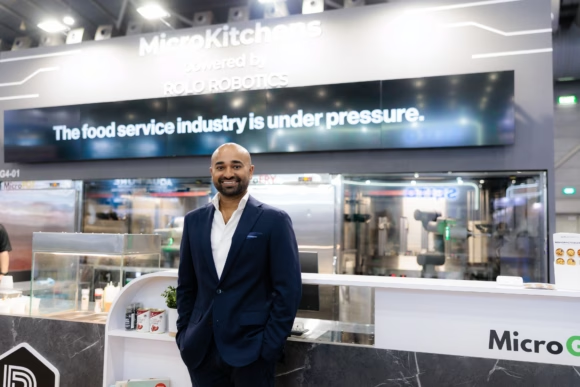
Ben Dixon, Founder of Fonto (a data and research company that connects daily transaction data with survey responses across 90,000 Australian consumers) put the challenge plainly in a session at Food & Hospitality Week 2026.
“QSR customers have more choice than ever before,” he said, noting that the competitive landscape has also widened well beyond traditional fast food rivals. Hot food at 7-Eleven, ready meals from Woolworths and Coles, Zeus Street Greek in supermarket aisles, and a growing share of grocery orders flowing through Uber Eats and DoorDash (34% of which, according to Fonto’s data, are for a meal or a snack rather than a full shop) all compete for the same stomach share.
Against that backdrop, Dixon made the case that how brands think about their customers needs to evolve. Specifically, he argued that occasion-based segmentation, which means understanding the context in which someone is making a fast food decision, is a more powerful growth tool than traditional demographic or attitudinal profiling.
Why Demographics Aren’t Enough
Most QSR brands are familiar with demographic segmentation: breaking customers into groups by age, gender, location or income. It’s a useful foundation, but Dixon described it as “quite static.”
Attitudinal segmentation, which groups people by how they think or feel about the world, can add nuance, but it doesn’t reliably predict behaviour either.
What’s missing, Dixon argued, is context. “The context is different for the same person, but it’s a different occasion. Same consumer, different moments.”
The insight sounds simple, but its implications are significant. A 38-year-old parent isn’t the same customer when they’re grabbing a coffee on the way to work as when they’re feeding the family on a Friday night, or sharing a meal with their partner after a long week. Their needs, their priorities, and the brand they reach for can be completely different each time, even though they’re the same person.
Occasion-based segmentation is built around that reality. Rather than asking who the customer is, it asks: what are they trying to accomplish right now, and who are they with?
Six Occasions That Define the Category
Working across 50,000 QSR occasions in Fonto’s dataset, modelling for group size, composition, and the functional and emotional needs being met, Dixon’s team identified six distinct segments. They split evenly between solo and group dining occasions, and more than half of all QSR visits in Australia, he noted, are solo.
The three solo segments are:
The Routine Set-Up. The habitual buyer. Grabbing breakfast, picking up a coffee, doing what they always do. This segment is driven by convenience and repetition rather than active decision-making.
The Favourite Craving. Someone who knows exactly what they want. “I’ve got a craving, I can smell it, I can taste it,” as Dixon put it. This is a moment of deliberate indulgence, and it’s becoming the dominant occasion in the category.
The Health Pit Stop. A smaller segment: loyalty programme members, quality-conscious buyers, looking for something that offers a sense of balance or reward.
The three group segments are:
The Family Feed. The perennial negotiation. Convenience and accessibility matter most, and often more than one brand wins.
Just the Two of Us. The partner occasion: whether that’s sharing a bucket, splitting a pizza, or a quick meal before a movie. Dixon described it as “a version of the date night, but with fast food.”
The Get-Together. Friends on the weekend, looking for somewhere open, welcoming and affordable.
The Numbers That Should Worry QSR Strategists
Dixon presented data current to March 2026 showing a sharp shift in how these occasions are distributed, and it points to real structural change in the category.
The Routine Set-Up segment, which once represented 32% of all QSR occasions, has fallen to 18% in the past 12 months. The Favourite Craving segment has moved in almost the opposite direction: up from 18% to 30% over the same period.
That’s a seismic shift in the nature of demand. Habitual purchasing, the reliable repeat visit driven by inertia and routine, appears to be weakening. In its place, people are visiting fast food more deliberately, driven by a specific want rather than a standing habit.
Dixon pointed to several forces at play, including changes in how people eat at breakfast time and shifts in habitual behaviour driven by broader lifestyle trends. But whatever the cause, the implication for brands is clear: you can no longer rely on being someone’s default. You have to be their choice.
Mental Availability by Occasion
That’s where the concept of mental availability becomes critical, and where occasion-based thinking translates directly into competitive strategy.
When Fonto asked consumers how many brands they considered before making a QSR decision, the answer was stark. Across all six segments, more than 60% of the time people considered just one brand. In the Favourite Craving segment specifically, that figure rose to 78%.
“How do you make yourself that brand?” Dixon asked. “How do you make yourself for as many of those occasions as possible the one brand they consider on that occasion and then make yourself available, make yourself easy to order, and make yourself well and truly in the competitive set?”
Looking at who currently owns the Favourite Craving moment, McDonald’s accounts for 30% of occasions in that segment, followed by KFC at 22% and Hungry Jack’s at 12%. But Dixon flagged two challengers, Guzman y Gomez and Soul Origin, as over-indexing in this segment relative to their overall market size. Both are finding ways to become the craving answer for specific customer groups, and the data (current to April 2026) supports it.
What It Means in Practice
For QSR operators, the practical payoff of occasion-based thinking shows up across almost every commercial function.
Menu development becomes more targeted. Understanding which food and drink combinations drive satisfaction on a Favourite Craving visit, for instance, is different from what drives a Routine Set-Up. Dixon’s team tracks 23 food items and 14 drink categories across segments, allowing brands to connect menu decisions to occasion data rather than just aggregate sales.
Media and marketing strategy shifts too. Rather than targeting demographic cohorts, brands can build messaging specifically designed to win mental availability in each occasion, appearing in the right context, at the right moment, with the right cue.
In-store activation, loyalty programme design and portfolio strategy all follow the same logic. If the Routine Set-Up occasion is declining and the Favourite Craving occasion is growing, a brand that’s built its acquisition strategy around habit formation needs to rethink how it creates desire.
The broader point Dixon returned to throughout his session was measurement. In a market where consumer behaviour is shifting, with occasions changing, channels multiplying and category lines blurring, the brands best positioned to adapt are those with real-time visibility into what’s actually driving choice.
“You need to be able to understand and respond as trends change, as customer preferences change, and customer occasions change,” he said. “That way you can build for adaptive and sustainable growth.”
In a category that’s getting more crowded by the month, that kind of precision may be the difference between growing and simply surviving.
Ben Dixon is the Founder of Fonto, an Australian data and research company. He spoke at the Business Stage at Food & Hospitality Week 2026.