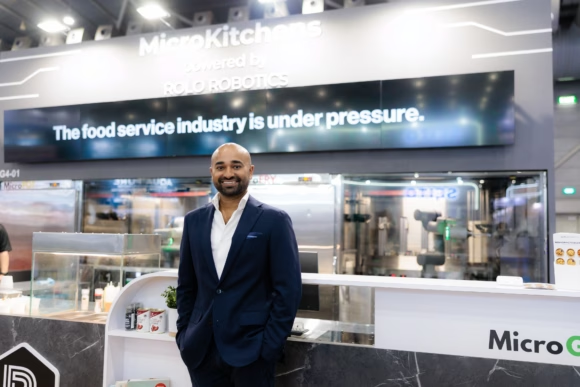
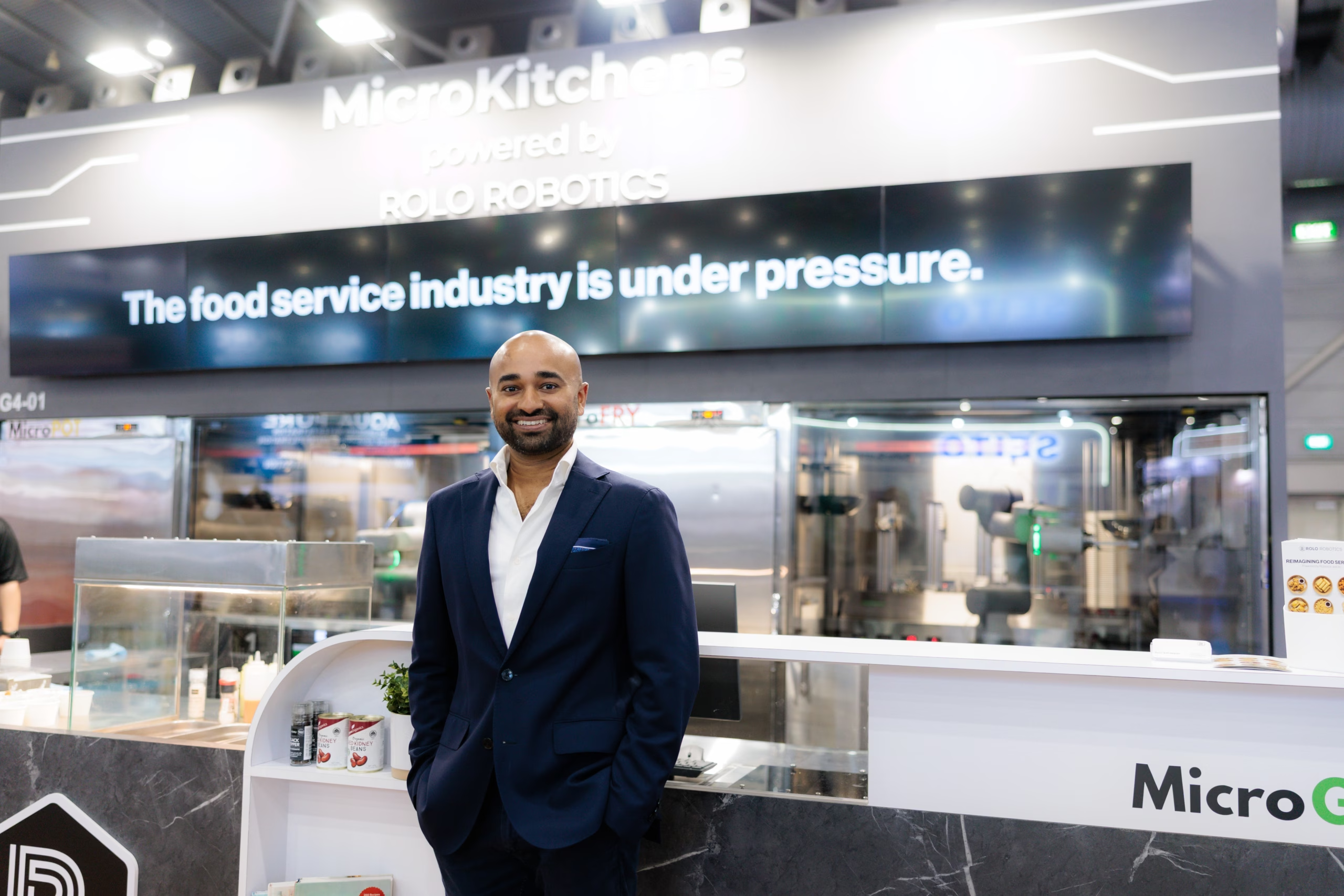
In this interview, Ravi Nahappan, co-founder of Rolo Robotics, shares the journey behind the idea, the problem he refused to accept, and what he thinks the industry gets wrong about automation.
Before Rolo existed, what were you seeing in the hospitality industry that others seemed to be ignoring or just taking for granted as the way things are?
The industry has spent centuries perfecting the craft, but nobody had touched the operating model. A chef per station, the production line, the way we prep, cook and serve. That model was designed hundreds of years ago, and we all accepted it as simply how a kitchen works. I wasn’t watching this from a distance. I’ve spent two decades in food manufacturing and running restaurants across multiple countries, and a multi-brand restaurant group across Singapore and India has given me a front-row seat to these pressures. Everywhere the conversation was the same: labour is short, rents keep climbing, delivery has changed the economics. Everyone treated those as separate problems to be managed. Very few people were asking whether the model underneath was still fit for purpose.
Was there a moment that really brought it home for you?
There was one job interview I’ve never forgotten. A young candidate who genuinely wanted to make it work in kitchens, but they would only do four days a week, and no weekends. Isn’t that when restaurants are busiest? On top of that, they told me, quite matter-of-factly, that they could make more money on TikTok. That was the moment I realised this was unsustainable long term. Not because of one person’s choice, but because of what it said about the pipeline: the model needs people most at exactly the times people no longer want to work, and it competes with alternatives that pay better. COVID hit our industry hard, and many of the people who left never came back. It left a hole where the next generation of hospitality careers should be, from QSR through to fine dining, and QSR naturally has it worse. Attrition has always been a challenge. When you’ve hired hundreds of people, you see it up close. But most of all, consumers are now paying more than ever just to keep the current operating model relevant. That’s the part I refused to accept.
What were you doing before Rolo, and is there a moment you can point to where you thought, this is the problem I want to spend the next decade solving?
Food is in my DNA. My family has been in the food business for three generations. I started my career in FMCG with Cadbury’s before moving into the financial markets, but I found my way back, and it was only when I returned to food that I realised I was home. Since then I’ve worked in food manufacturing and opened restaurants in multiple countries. The moment it became “the next decade” was meeting my co-founder, Tushar. Before he became an engineer building and shipping robots around the world, he worked nights in restaurants, bars and convenience stores. He lived the labour problem from the front line; I lived it as an operator. We were looking at the same problem from opposite sides, and once we saw that, it was hard to look away.
When you started talking to operators early on, what were they telling you? What did those conversations actually sound like?
The honest answer is I didn’t have to go looking for those conversations. I was the operator, and my peers were saying exactly what I was seeing across my own outlets. What struck me was how universal it is. Europe, the US, Australia, even developing markets. Labour supply and availability is a challenge in every one of them. Margins are getting squeezed. Delivery keeps changing, and the shift in channels squeezes them further. And consumers have more choice than ever. The conversations themselves were very practical. Rosters they couldn’t fill. Staff they’d spend weeks training who’d leave within months. Rent reviews. Not one operator asked me for a robot. They asked for a way to keep serving good food without burning out their team or their P&L. There was healthy scepticism too. Hospitality has seen plenty of gadgets that promise the world and end up in the storeroom. I’ve been pitched most of them myself. That scepticism shaped how we build: if a product doesn’t improve an operator’s economics, it doesn’t leave our workshop.
At some point, you decided a modular, scalable autonomous food system was the answer. Why that, rather than a staffing platform, a training programme, or something else entirely?
Because the staffing shortage is the symptom, not the disease. A staffing platform helps you fill holes in a model that needs too many people doing repetitive work in expensive real estate. Training and supply chain can only take you so far. They don’t change what the work is. We kept coming back to one question: what if we stopped trying to make an outdated operating model work, and built a better one powered by automation, robotics and AI?
A modular system that runs autonomously or semi-autonomously made sense because no two kitchens are the same. Layouts vary. Demand rises and falls for all sorts of reasons, and capacity has to follow it in both directions. Mobility mattered just as much. A traditional kitchen fit-out is bolted into the building, and when a site closes there is very little salvage value; it becomes a write-off on the balance sheet. Our systems can be moved and redeployed to the next site, so the asset holds its value.
If machines take on the repetitive, physically demanding and hazardous work, people are freed up to do what only people can do: cook with creativity, look after guests, build the business. That’s a structural fix, not a patch. Tushar and I see a new operating model that ultimately leads to better pay for the people in this industry, a real focus on hospitality and better service, and most of all lower prices for consumers. This is a democratisation of freshly cooked and prepared food.
What was the hardest thing to get right in building Rolo? Were there moments where you genuinely weren’t sure it was going to work?
Building a hardware and software business at the same time is genuinely challenging. Kitchens are brutal environments for machines. Heat, oil, humidity, long days. And food doesn’t forgive inconsistency. The first step was building a deterministic system. If a customer orders fish and chips, that’s what we have to serve, consistently and every single time. Getting the same great result on cycle five thousand as on cycle five is much harder than any demo. Now we’re building the intelligence layer, using computer vision and AI to make the systems smart. Being a restaurateur keeps us honest here. I know exactly what a machine has to put up with on a Saturday night, because I’ve stood in that kitchen. And yes, there were moments of doubt. Anyone building hardware who says otherwise isn’t being straight with you. We hold everything to a simple bar: if it doesn’t improve the operator’s economics, produce consistently great food and make life easier for the people using it every day, it isn’t ready.
How much has the idea changed from your earliest version to what Rolo is today? When did the modular architecture reveal itself as the direction you needed to go?
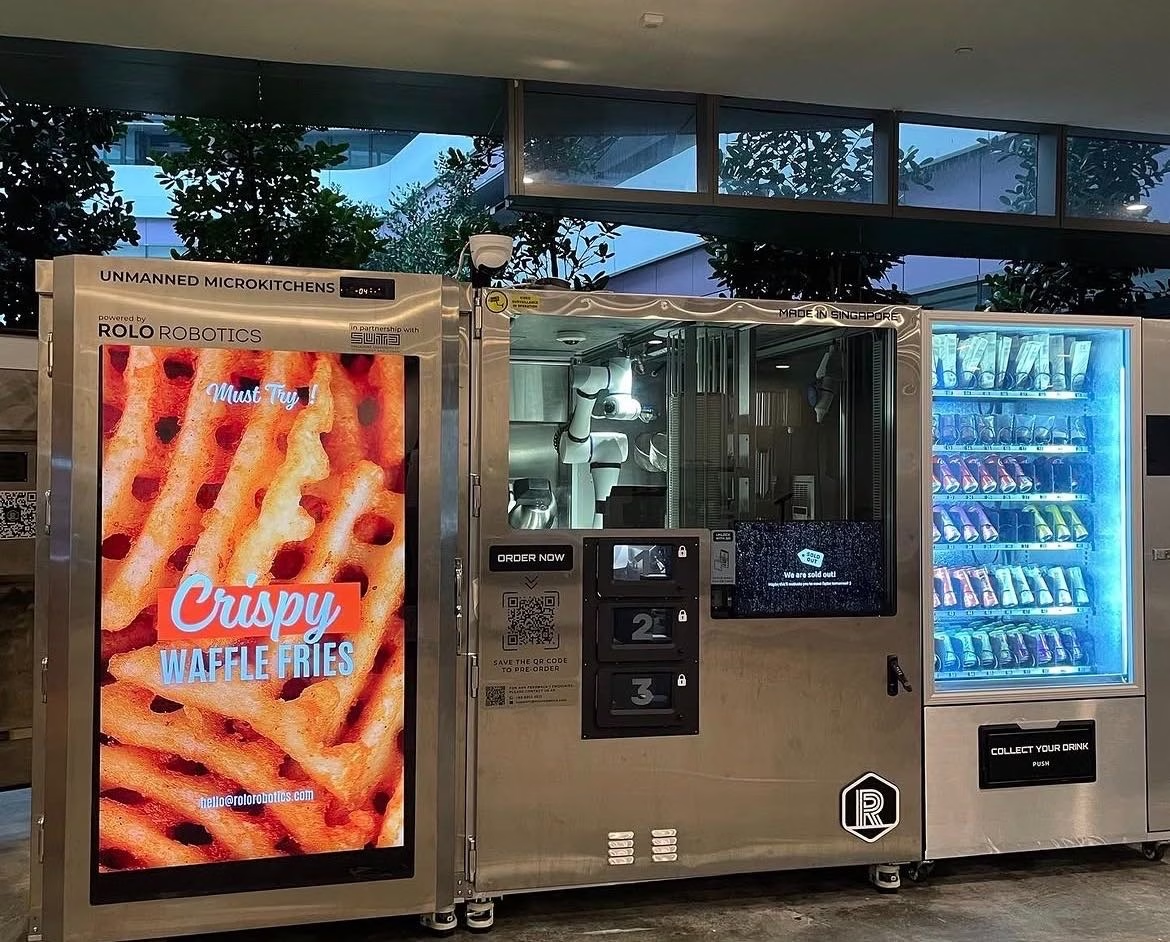
A lot. We started with a single machine, a frying system we called Maya, which is now MicroFRY. It worked, but it solved one station, and a kitchen isn’t one station. The lesson from putting it in front of real operators was that they don’t buy a machine, they run an operation. That’s when the modular architecture revealed itself: MicroFRY became one of several cooking automation products and systems that make up our MicroKITCHEN platform, so an operator can start with what they need and grow the system as demand grows. The rename tells the story. We stopped building a product and started building a platform.
The system is always on, self-cleaning, and scalable from a single cell to twenty. Was that the vision from day one, or did the scale of what you were building reveal itself as you went?
The vision has stayed the same from day one. The real challenge has been how we get there, through a series of milestones. But we always knew the system had to make an operator’s life easier. Take cleaning: if a machine needs a person to strip it down every night, you haven’t removed the labour, you’ve just moved it. Same with uptime: food demand doesn’t keep office hours, so the system can’t either. And the scalability comes from the places we want to serve. A remote site with two hundred people and a busy airport terminal don’t need the same capacity, but they deserve the same food. One cell or twenty, it has to be the same system. There are plenty of passionate people in our industry. They’re just being hit hard by the daily firefighting. Everything we build should take some of that off their hands.
You’ve watched Rolo cook a lot of meals. What’s your favourite dish that comes out of it?
The fried chicken out of MicroFRY. I’ve eaten more of it than I should admit, and batch five thousand tastes exactly like batch five. That consistency is the whole point. I’m looking forward to the day we can make my favourite nigiri, though.
There’s still real resistance to automation in hospitality, around jobs, food quality, and losing the human element. What do you say to people who raise those concerns?
I understand the resistance, and some of it is earned. The industry has been burned by technology that put itself between people and their meal. Our view is simple: robots shouldn’t replace people. Robots and humans should work in harmony. Machines are good at the repetitive, physically demanding and hazardous work. Those are the roles operators already can’t fill today. People should do what only people can do: create, cook with imagination, look after guests. On food quality, we hold the machine to a higher standard than a slammed kitchen at 8pm on a Saturday, not a lower one. As for the human element, technology is always an enabler to a better outcome, not the outcome itself. The novelty of robots will die. What we need to build are reliable kitchens that cater to the challenges operators face. Technology shouldn’t become the experience. It should quietly make the experience better. If anything, we want to bring hospitality back.
Ten years from now, what will the Australian foodservice industry look like, and where will Rolo fit into that picture?
Freshly cooked and prepared food will be available in places the traditional model could never afford to serve. Beyond the robotics and autonomous systems, Rolo is about serving the underserved: people working the tough hours, FIFO workers, students on university campuses, travellers moving through train stations and airports, and those serving in defence, to name a few. Australia feels this more than most countries: huge distances, genuine labour shortages, and communities that deserve better than reheated food because a full kitchen crew doesn’t stack up out there. In ten years, I think back-of-house looks more like modern manufacturing: compact, automated, reliable. Front-of-house becomes more human, not less. Every industry has been through this shift: manufacturing, warehousing, finance. Foodservice is next, not because it’s fashionable, but because it’s necessary. Rolo’s job is to build the operating model that gets it there.
Visit www.rolorobotics.com to find out more about their products.