Walk into any shopping centre food court in Australia right now and count the chicken concepts. Then count everything else. The maths tells the story.
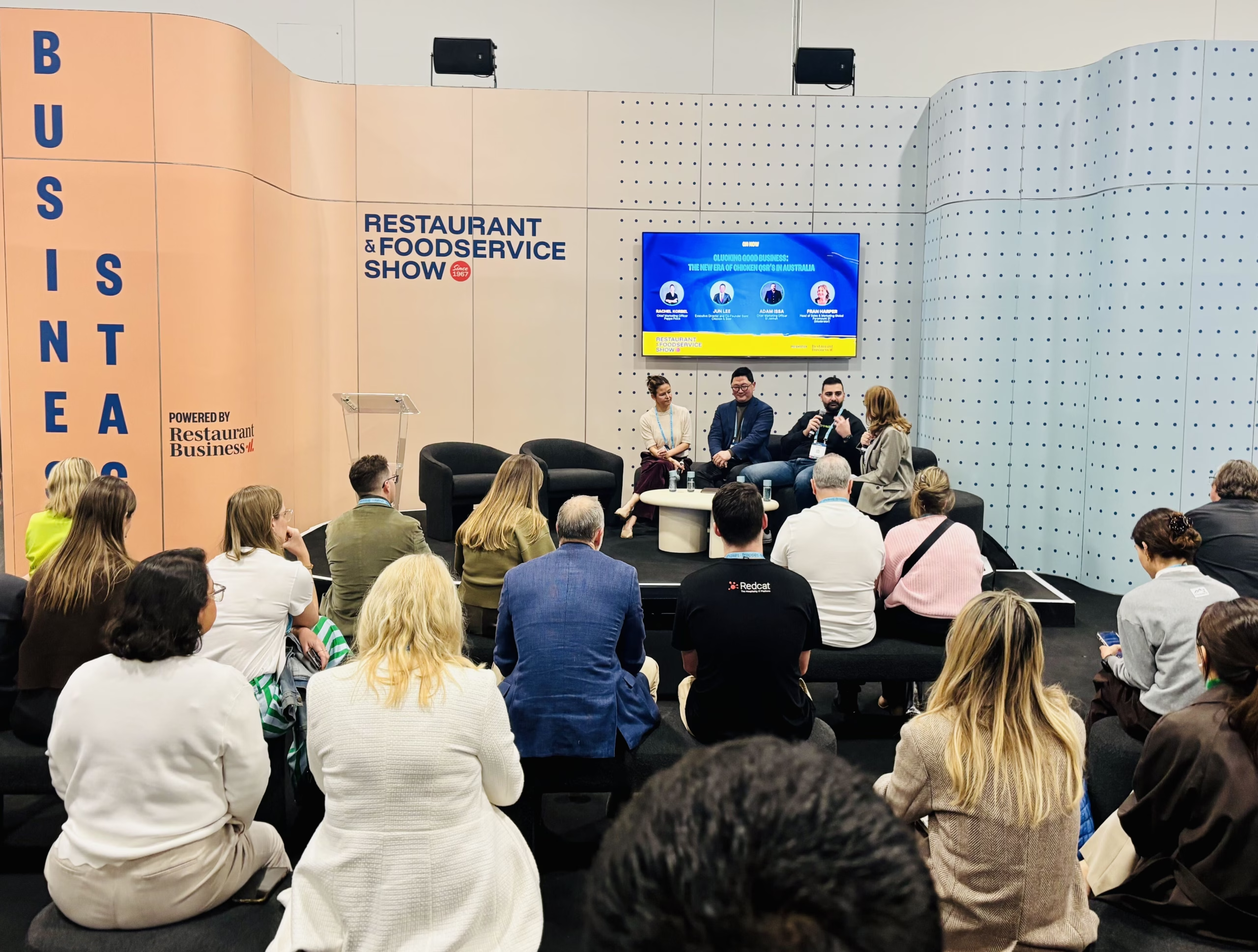
Chicken has become the undisputed protein of Australian quick service, overtaking beef not just in consumer preference but in menu investment, new brand launches, and franchise growth. At Food & Hospitality Week’s Business Stage on 25 May, three operators building very different businesses around the same protein took to the stage to unpack why, and where it goes from here: Rachel Korbel, Chief Marketing Officer of Pappa Flock; Jun Lee, Executive Director and Co-Founder of Gami Chicken & Beer; and Adam Issa, Chief Marketing Officer of El Jannah.
Their answers, taken together, amount to something more than a trend piece. They suggest a structural shift in how Australians eat, and who gets to feed them.
The economics are hard to argue with
Ask any of the three panellists why chicken is winning and economics comes up first.
“Chicken is just a cheaper protein to manufacture,” said Korbel, who spent years working across beef brands before building Pappa Flock. “More scalable, sustainable supply, easier to portion than beef, faster to grow. Beef cattle take two to three years, chicken takes 50 days.”
That supply-side advantage flows directly to operators: lower cost of goods, more consistent supply, and a product that’s easier to portion and price predictably. In a market where margins are under pressure from every direction, those fundamentals matter enormously.
But Jun Lee, who founded Gami Chicken & Beer and has spent the last decade building it to around 30 outlets across four states, argues the economics are only part of the story.
“Chicken is the only protein accepted in all cultures,” he said. “In some cultures, beef is not accepted. In some cultures, pork is not accepted. Chicken, people eat it every day, every week, from Asia to Europe. It doesn’t really matter.”
In a country as multicultural as Australia, that cultural universality creates a natural demand floor that no other protein can match. Beef, pork, and lamb each have segments of the population who won’t touch them. Chicken doesn’t.
Flavour is where the real competition lives
If the economics explain why chicken dominates, they don’t explain which brands win within the category. All three panellists were clear that the protein itself is now table stakes; what differentiates operators is what they do with it.
El Jannah’s version is Lebanese charcoal chicken, marinated in-house from birds that come in cold, part of a supply chain the brand controls from end to end. Around 70 to 80 per cent of what customers eat at El Jannah, including the hummus, the chickpeas boiled and blitzed with tahini and lemon, and the chicken itself, is made by El Jannah. “Food is at the forefront of everything that we do,” said Issa. “That’s what’s built this brand over the last 28 years.”
Gami’s point of difference is Korean fried chicken and beer, a social eating format Lee describes as the Korean equivalent of a British pub. “When you’re happy, when you are sad, if you need some good food with affordable price, that’s where we wanted to bring those service and product to this lovely country.”
Pappa Flock’s differentiation is built around freshness as a discipline. Tenderloins are hand-breaded in store every morning. Lemons are cut and squeezed in store every morning. “It’s a deliberate choice. It’s an expensive choice,” said Korbel. “But our customers can taste the difference.”
Issa’s observation cuts to the heart of the category dynamic: “There are a lot of operators that are probably not giving chicken the amount of respect it needs. Everyone in the market has realised that chicken is the cheapest protein at the moment. They can plug it on the menu as an add-on, whether it’s wings, tenders, or the likes. But we know where we play and how we look after the protein itself.”
International brands are coming. The incumbents aren’t blinking.
The arrival of well-resourced international brands eyeing the Australian market was the elephant in the room, or perhaps the chicken in the coop. The panel addressed it directly, and the consensus was measured confidence rather than complacency.
When pushed to name the brand that would give them pause, Korbel nominated Chick-fil-A. “They have such strong values, such an incredibly strong community, and they’ve been able to sustain that for 80 years.” Lee said he’d welcome In-N-Out, citing “there’s so much to learn” from brands that have sustained community across 50 or 60 years of growth. Issa pointed to Cava, a Middle Eastern Mediterranean brand he’s watching closely in the US.
But all three circled back to the same point: success in America does not translate automatically to Australia, and history supports that view. Taco Bell, Carl’s Jr., and others have come and struggled to find footing here. Starbucks famously retrenched.
“Aussie consumers love supporting Aussie businesses,” said Korbel. “These big international brands can buy their way into the market, but they can’t necessarily buy their way into belonging.”
Issa framed it in terms of what the Australian palate has actually become: “I reckon we have some of the best food in the world here in Australia. Fifteen years ago, none of us were eating sushi. Today sushi is a staple. No one knew what charcoal chicken was probably 15 years ago. Now there’s one popping up on every corner.”
The point being: Australian consumers have developed genuine sophistication and genuine loyalty. International brands with no roots here have to earn both from scratch.
What actually builds a chicken brand
The session’s sharpest exchange came when the panel moved from product to brand. Korbel drew the distinction plainly: “A menu and a product can be copied. A price point can be copied. What you cannot copy is the brand experience and the relationship that we’ve built with our flockers.”
She offered concrete evidence. Pappa Flock, founded in 2023 and still a young brand by any measure, drew more than 400 customers queuing before the doors opened on its first Queensland store in Chermside. Influencers Jenna and York from The Voice chose a Pappa Flock restaurant for their engagement party without being asked.
“It’s those type of moments that make a brand and help you cut through in a competitive space. Product and price only get you so far.”
Lee’s version of the same idea was characteristically direct: “If on Friday night, AFL is coming up and on the way back I’m picking up Gami and having a beer watching the AFL, then I can actually say I truly became an Australian brand. Not because I sourced everything Australian, but because we became part of their routine. We became a crucial part of their life.”
Issa described El Jannah as one of only two products, alongside pizza, that still brings Australians together around a shared dinner table, and said sustaining that is central to everything the brand is building.
The Business Stage session ended on a note that felt less like a panel closing and more like a category coming into its own confidence. Three brands, three very different takes on chicken, and one shared conviction: the market is growing, the competition is sharpening, and the operators who understand that this is fundamentally about belonging, not just protein, are the ones building something that lasts.
Rachel Korbel (CMO, Pappa Flock), Jun Lee (Executive Director and Co-Founder, Gami Chicken & Beer) and Adam Issa (CMO, El Jannah) spoke on the Business Stage at Food & Hospitality Week, moderated by Fran Harper, Head of Sales & Marketing Global at Paramount 21.