Where did your love of food come from?
My love of food came from a love to eat! I grew up in a small town and exploring food was another way to explore the world.
What was your first role in the industry and what was the most significant lesson it taught you at the time? My first role was at Quarry Oaks Golf Course. I was a breakfast cook. The chef I worked for didn’t believe in recipes, only ingredient lists and it taught me to use my tastebuds and cook by instinct.
Tell us about your current restaurant and its menu – what excites you most about it at the moment?
At the moment I oversee 13 kitchens around Sydney. I love it all from the small intimate venues to the organisational challenges presented by something high volume like Opera Bar.
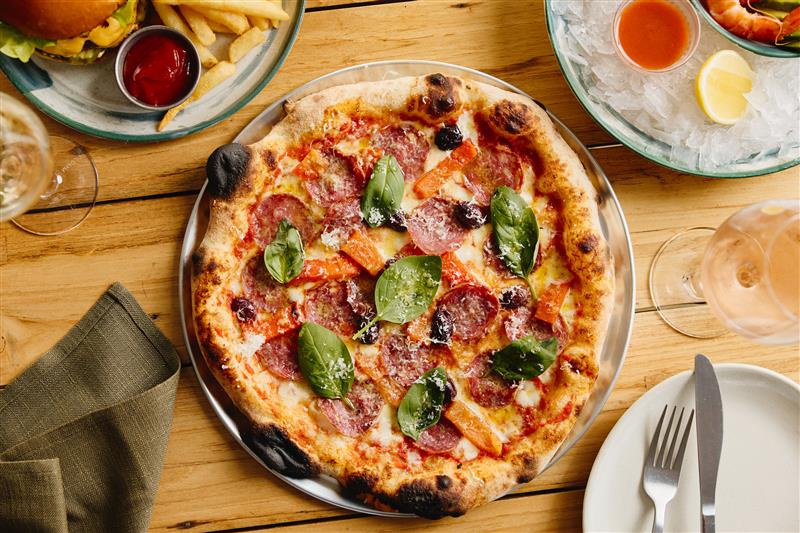
What’s the most interesting ingredient, product, or technique you’ve been exploring lately—and why? Flour! Learning more about bread, pizza and panettone lately. I love to learn and push myself to learn new techniques and recipes all the time.
Do you do anything day-to-day that helps you to tap into your creativity or source new ideas?
I always explore our city. Whenever I visit a new supplier or have a meeting, I like to explore around the suburb. The other important aspect for creativity is making space and getting out into nature.
How are guests and their changing expectations making you think about your approach?
I think our guests expectations are always rising as well as their knowledge and dietary restrictions. I love that we never sit still and always have to adapt.
Are there any food trends you’re embracing or intentionally pushing back on right now?
I love the latest trend of beans. I like beans. I don’t like to be a hater. If you like a trend go for it.
What’s the best thing about being a professional chef?
Getting to explore and meet new people. Getting to taste new things. Teaching young people. So many great things.
What about your current role or experience keeps you up at night?
The never ending problem solving, managing people and their expectations, equipment failure, turning businesses profitable.
How do you switch off from the stress?
I’ve recently taken up tennis which is lots of fun and helps me switch off.
What’s one piece of advice you’d give to your younger self?
Slow down a bit! Don’t need to do it all this year.
Who’s impressing you in the industry at the moment and deserves a Restaurant Business shoutout?
I’m continuously impressed by the food and style of Oscar Solomon.
On kitchen leadership
What does a well-run kitchen look like to you—and what principles guide how you lead it?
Calm, organised and clean is my idea of a well run kitchen, incidentally they’re also the principles I try to follow.
What operational shift or system change has had the biggest positive impact on your kitchen recently? Outsourcing. With scale allows you to outsource and get suppliers to make your products for you which allows your chefs to spend the limited time on focusing on cooking and seasoning.
How do you approach training and mentoring—especially when developing future leaders in your team? Build relationships first. Take time to show them your vision and try to make it a shared vision. Give them a bit of space and a gentle nudge when they need it, but also trust their intuition and skills.
What’s your experience with kitchen tech or automation—what’s actually helped, and what’s just hype? A good quality dishwasher is worth the money. It gives you a chance to cut labour and spend your limited labour budget on making sure there are enough Chefs in the kitchen.
How do you manage rising food costs and supply challenges while still maintaining quality and creativity? That’s one of the fun parts. It’s always a balance between what people are willing to spend, what you can afford to put in from a labour perspective and how much products are costing you.
What’s your approach to keeping calm, consistent service during the pressure of peak periods?
This is a life long pursuit but taking a minute to step back, than slow down to speed up. At a high volume venue I love the use of bump screens to allow you to track wait times as well as limiting how much you can see at once so it doesn’t feel too overwhelming. I learned a lot from Shaun Hyland at HSW in Brisbane. He’s the king of a crushing a calm service.
How do you create alignment and collaboration across front- and back-of-house teams?
We communicate about our shared vision and work on collaborative decision making and constantly touch base with each other.
What are the biggest leadership challenges you’re facing right now—and how are you tackling them?
I wouldn’t call it a challenge, more a work in progress but taking over a huge venue and developing a really solid team of chefs has its tough moments. We’ve also expanded our offerings so finding skilled chefs who can prep dishes like sushi which require a lot of finesse has taken some time.
What role do you play in shaping the long-term vision of your venue or hospitality group?
I think I get to play a decent role in shaping the offering that our concepts offer. I’m very fortunate to get to work closely with a team of directors that set the tone for the business and get to have an input in the creative direction of what we offer.
What separates a strong cook from someone ready to lead—and how do you help your team make that leap? Someone who brings people together, that has intrinsic standards and motivation and a strong drive. We hope to notice these people and spend lots of time nurturing them into these positions. Developing talent from within is always a fantastic way to run a business.