When James Sun opened his first Butcher’s Buffet in Haymarket in late 2020, it might have looked like bad timing. Sydney was just emerging from the first COVID lockdown, and the idea of a self-service buffet felt at odds with a dining scene that had pivoted almost overnight to delivery, QR codes, and cautious distancing. But Sun, who had already road-tested the concept at Strathfield, saw things differently.
“People actually felt more comfortable in larger restaurants,” he tells Restaurant Business. “They thought it was more spacious, more hygienic. As soon as restrictions lifted, we were getting smashed at Strathfield.”
That surge of pent-up demand gave him the confidence to push into Haymarket, the neighbourhood he grew up in and still calls his “second home.”
Today, he runs three venues, including Butcher’s Buffet, Gyuniku (a premium Japanese and sushi buffet), and Shabuway (a shabu-shabu concept). Each has its own identity, but the model is consistent: strong value, plenty of choice, and a set-price format that puts the diner in control.
It’s an approach that’s proving resilient in a time when operators are under pressure from rising costs and shifting consumer habits.
Modernising the buffet
If you’re picturing steam trays and sneeze guards, think again. Sun has reimagined the buffet for a generation that expects both value and experience. “Traditionally, Korean barbecues had very traditional fit-outs,” he explains. “We wanted to move away from that, and bring in the K-pop vibe, with neon lighting, music videos, and younger energy.”
That same attention extends to the food. While the model is volume-based, the philosophy is simple: fresh, not frozen.
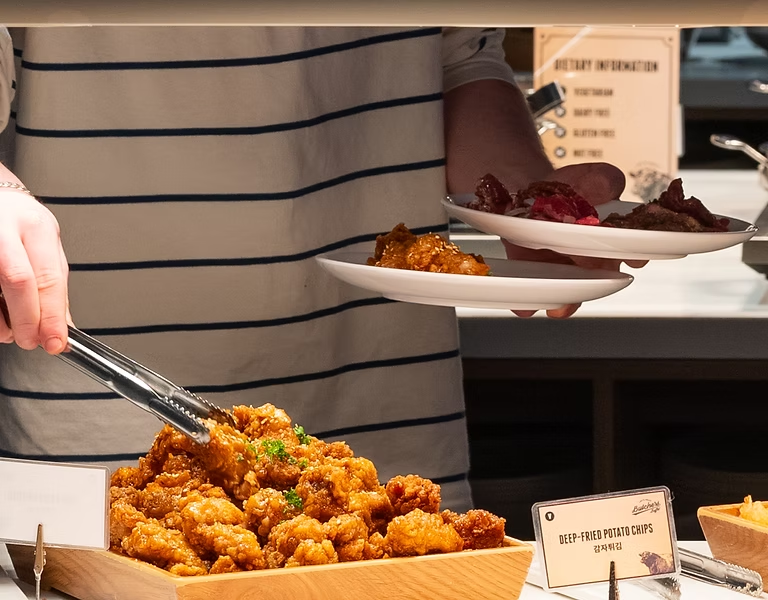
“Meat is what people pay for, so it has to be right,” Sun says. It’s a point of difference he’s stuck to, even as competitors cut costs. “Yes, it’s more expensive, but that’s what sets us apart.” Diners pay a flat price, help themselves, and still get small but important service touches, such as a warm welcome, attentive staff changing grill plates, and a sense that they’re looked after even in a high-turnover environment.
Scaling a business
Buffets might run on thin margins, but Sun sees scale as the answer. Butcher’s Buffet has since grown to six locations, with a seventh due to open at Castle Hill this year. Haymarket, meanwhile, has become the nucleus for experimenting with spinoffs like Gyuniku and Shabuway.
“It’s not about a quick brand and quick money,” he says. “I’m fourth generation in this industry. It’s about longevity and sustainability.” Profits are reinvested into the business or set aside for future expansion, keeping the pipeline steady.
There are challenges, of course. Staffing remains the biggest challenge, particularly finding loyal, skilled back-of-house staff in a market where younger workers are steering clear of trades like butchery. “What used to take one or two months to train now takes six to eight,” Sun says. “And there’s no guarantee they’ll stay.”
Still, the model is proving resilient. The simplicity of a set-price buffet helps manage costs, while the high turnover ensures volume. The multiple brands give him flexibility; he can test new formats without diluting the core Butcher’s Buffet identity.
What diners want
For other operators, Sun’s success offers insight into the post-pandemic diner. Value is non-negotiable, but so is experience. Customers want variety, freshness, and a sense of occasion, whether that’s a sushi counter or a table grill with neon K-pop aesthetics.
They’re also eating out less frequently, but making those meals count. “They want indulgence, and they want to know they’ll have a good experience,” Sun says. Social media amplifies the effect: photogenic buffets and viral “all you can eat” offers drive foot traffic in a way that traditional advertising can’t.
It’s why Sun believes the buffet is having a resurgence, not just in casual dining but across the board. Italian restaurants offering two-hour pizza and pasta feasts, steakhouses experimenting with unlimited set-price menus, the “all you can eat” idea is proving adaptable.
The long game
Looking ahead, Sun is focused on both expansion and refinement. Castle Hill and Marrickville are next on the map, and he’s eyeing opportunities to scale Gyuniku and Shabuway beyond Haymarket.
But the strategy remains the same: don’t overcomplicate the business. Keep the food fresh, the fit-outs distinctive, the service warm, and the numbers will follow.
“Buffets are about volume, but they’re also about experience,” he explains. “If you can give people both, it works.”
In a market where operators are looking for models that balance value with sustainability, Sun’s empire-in-the-making is one to watch. Haymarket might be his second home, but for the self-service dining crowd, it’s fast becoming the capital of a new kind of buffet.