The biggest lie in hospitality? That sustainability is expensive.
With operators continuing to face pressure from rising wages, utilities, insurance premiums, and food costs, sustainability initiatives are increasingly being viewed through an operational efficiency lens rather than a purely environmental one.
Sustainability is often framed as a cost. But according to industry experts, the reality is quite the opposite. When implemented effectively, sustainable practices can reduce waste, improve efficiency, and strengthen profitability.
“I think people confuse cost with effort,” says Alex Bell, chemical engineer and founder of Milton Distillery and Bi Artisans. “It doesn’t cost a lot to do these things. If anything, it’s negative cost. It actually somewhat makes you money. It’s just the effort of implementing the new processes and training.”
That distinction—between upfront effort and ongoing expense—is critical for operators juggling labour shortages, rising costs, and the day-to-day demands of running a venue. The hard part isn’t usually the price tag. It’s finding the time to change habits, train staff, and stick with new systems beyond the initial burst of enthusiasm.
The bin is your biggest cost centre
Keary Chandler, sustainability consultant and representative of the Food Made Good standard in Australia, cuts to the chase: start with what you’re throwing away.
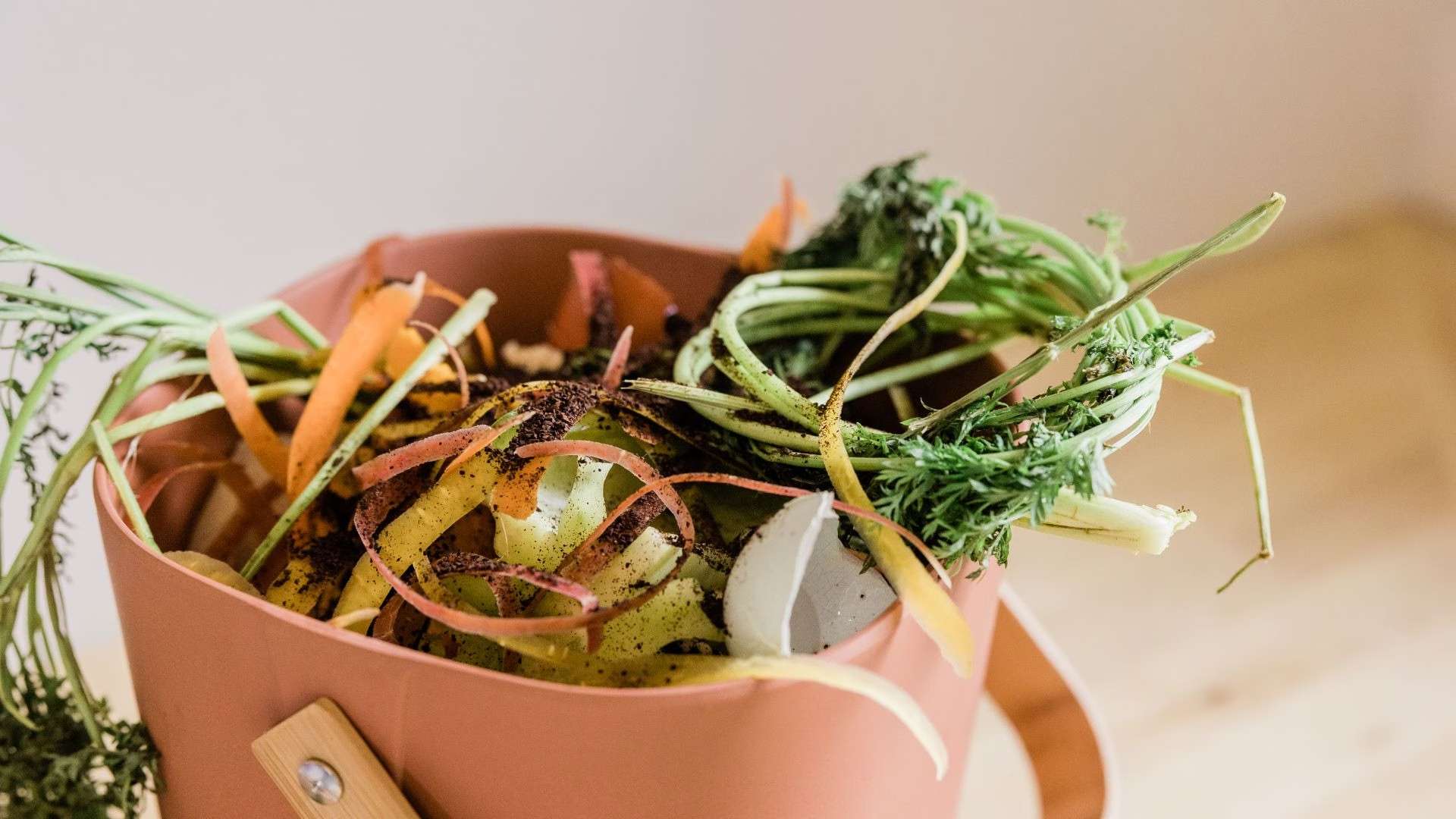
“If you would just start something simple and commit to starting whatever that might be—say, for example, reducing food waste—you might just start to measure that and recognise how much food waste and essentially cost you’re throwing away,” Chandler explains. “From your food preparation to the spoilage that happens in your chiller to what comes back on the plate. If you would just simply measure that and then put that into dollar terms, that could be very revealing.”
No fancy consultants required. No certification fees. Just you, a notepad, and an honest look at your bins for a week. The dollar value of wasted onions, spoiled proteins, and untouched sides adds up faster than most operators realise—and that’s before factoring in the labour cost of preparing food that never gets eaten.
Reusables beat single-use every time
Katie Barton-Harvey, Project Coordinator at Boomerang Alliance’s Plastic Free Places program, has the numbers to prove reusables can stack up financially.
Working with large corporate clients across South East Queensland, her team developed a calculator that factors in everything operators worry about: waste management costs, compactor fees, dishwasher installation, additional labour for busing tables, and point-of-sale data on actual transaction volumes during peak periods.
The result? Reusables consistently outperform single-use products over time, even after accounting for operational changes and upfront investment.
“People think, ‘Oh, the dishwasher costs, the reusable costs,’” Barton-Harvey says. “We plug all of that in, and it’s showing with their data that reusables are beating single-use and the payback is within the first year.”
Consider the full cost of a disposable takeaway cup: the unit cost, waste management fees, storage requirements, and the labour involved in clearing and disposing of it. Meanwhile, a ceramic mug incurs no ongoing purchase cost after the initial investment, can enhance the customer experience, and can even become part of a venue’s brand story through initiatives such as mug libraries or reusable vessel programs.
The innovation dividend
Bell’s distillery operations offer a case study in how sustainability practices can create business resilience.
When flooding destroyed Milton Distillery in 2022, the business survived because it had already embraced rapid innovation over traditional production methods.
“Without it, we definitely wouldn’t have survived the floods of 2022,” Bell reflects. “If we had gone down the traditional way of producing rum, putting it into a barrel for two years, three years, ageing it, we would have been dead three years ago. But because we embraced that innovation aspect very early on, we’re able to produce extremely good products for technically a cheaper price.”
Using fruit waste as a vodka base. Accelerating ageing processes. Rethinking every input and output through an environmental lens. These weren’t charitable acts—they were competitive advantages that delivered stronger margins and faster inventory turns.
Free tools you’re not using
Operators don’t necessarily need deep pockets to begin improving sustainability outcomes.
A range of industry and government-backed programs continue to provide support for hospitality businesses looking to reduce waste, energy use, and operating costs.
Plastic Free Places offers membership, accreditation pathways, and resources to help venues reduce problematic single-use plastics and evaluate alternative materials.
EcoBiz provides assessments covering water, waste, and energy usage, alongside action plans designed to identify efficiency opportunities.
Food Made Good Australia offers a broader framework that examines sourcing, environmental performance, and social impact, producing a strategic report that helps operators identify risks, opportunities, and areas for improvement.
“It’s not a judgement, it’s not good or bad,” Chandler explains. “It’s just a business tool that enables you to look holistically at all the different parts of your business.”
Local councils are also increasingly offering sustainability support programs and grants, making it worth checking what assistance is available in your area.
The spreadsheet solution
For operators who prefer a DIY approach, Bell’s engineer brain offers the simplest tool available: a spreadsheet.
“My go to is always just to build the spreadsheet myself and then run the financials,” he says. “That’s a good exercise to do. You really need to understand the problem within your business, and the best way to do that is just by modelling everything with your entire supply chain.”
After each quarter, cross-reference your profit and loss statement with actual sales. If you sold 2,000 meals and your cost of goods sits significantly above target, that gap becomes your roadmap. Where did the waste go? The answer is often sitting in your bins, your walk-in cool room, and your preparation processes.
The payback timeline
Barton-Harvey’s surf club experience illustrates how quickly sustainable initiatives can gain traction.
When volunteers were given reusable patrol cups for their complimentary coffee and breakfast burritos, the response was immediate: “I feel pretty special.”
That emotional return compounds with the financial one. Every reusable cup deployed reduces the ongoing purchase of disposable cups while lowering waste volumes and collection costs. At the same time, it creates a more premium experience that volunteers—and customers—are more likely to photograph, share, and talk about.
The initial effort involved conversations with suppliers, staff training, and checking in during the first few weeks. The ongoing cost was limited to washing and maintenance. The return was immediate and ongoing.
Starting today
The experts agreed on the best first step: just start somewhere.
“Any change is hard because we are very comfortable in the status quo,” Chandler acknowledges. “But you don’t have to do it all. You just start with something. Look at your major pain points of perhaps where your business is at the most risk or having the most struggle, and see how that part could be alleviated.”
For Bell, that meant examining his supply chain with fresh eyes. For Barton-Harvey’s clients, it meant replacing single-use items with reusables one category at a time. For operators using the Food Made Good framework, it meant gaining an honest, third-party assessment of current operations.
The common thread? None of these starting points required significant capital investment. They required decision-making, communication with suppliers and staff, and follow-through on implementation.
“There’s cost now and there’s cost in the future,” Chandler notes. “So it depends on how you measure cost and impact.”
Sustainability is also becoming an increasingly important consideration for diners, investors, employees, and business partners. Practices that reduce waste and improve efficiency are no longer viewed solely through an environmental lens—they are increasingly recognised as indicators of a well-run business.
Measured honestly, sustainability isn’t an expense line item. It’s a profit centre hiding in your rubbish bins, your supplier invoices, and your operational inefficiencies. The question isn’t whether you can afford to implement sustainable practices. It’s whether you can afford not to.
This article is based on insights shared during a sustainability panel discussion featuring Alex Bell, Keary Chandler and Katie Barton-Harvey.