
The days of chasing the highest-paying job are over. Today’s hospitality workers want flexibility, purpose, and a workplace culture that values them as individuals—and they’re willing to walk away if they don’t find it.
“Gone are the days when you can just expect someone to take a job just for the money,” says Isaac Gorton, Hospitality Recruitment Specialist at Frontline Hospitality Queensland. “In my time in recruitment, I’m seeing a lot of candidates actually interview the business as well as the business interview the candidates.”
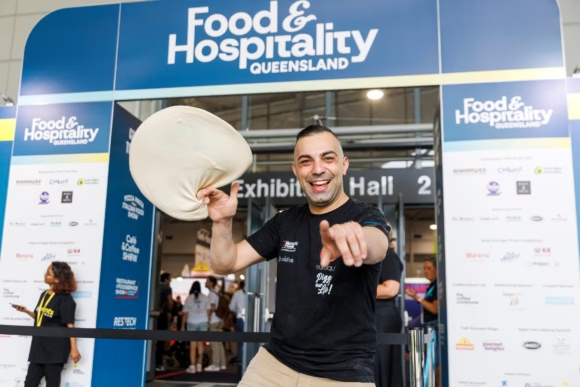
During a panel discussion at Food & Hospitality Queensland, operators and recruitment experts discussed how dramatically the hiring landscape has changed, and what venues need to do to compete for talent.
The new wish list
Gorton, who spent 20 years as a chef before moving into recruitment, says candidates are now asking for benefits that would have seemed radical even five years ago. Head chefs are requesting one day a week to work from home for menu costing and ordering. Line cooks want guaranteed evenings off for family commitments. And flexibility around children’s school events has become a deal-breaker for many experienced hospitality professionals.
“We’re seeing things like flexibility—working from home a day a week for a head chef when they’re doing the ordering or costing a new menu—and they’re really big ticket items on candidates’ wish lists,” Gorton explains.
Robert Smithson, Head of Culinary at dnata Catering & Retail, which produces 54 million meals annually for airline customers, says his team has had to completely rethink how they approach recruitment.
“You’re fundamentally pitching the role to people to attract them in, to come and look at what we’ve got to offer,” says Smithson. “It’s about providing an ecosystem. It’s not just about the money, it’s about the training, the experience, the exposure, and obviously the lifestyle.”
For dnata, that means structured rosters that allow employees to request specific days off for family commitments—a Saturday morning to watch a child’s soccer game, or an evening for a school play.
Culture over cash
Laura Goldberg, owner and COO of Hurricane’s Grill in Sydney, says authenticity and empathy have become critical retention tools when competing against larger groups with deeper pockets.
“I think authenticity, knowing what your brand values are, knowing what your values are as a business—we’re very fortunate, we have over 15 ten-year-plus staff members,” says Goldberg. “And I think it just really boils down to how we lead and how empathetic we are as leaders.”
Goldberg credits the presence of empathetic women leaders in her business as a significant factor in staff retention, noting that employees want to feel seen and valued as individuals rather than numbers on a roster.
Even casual staff are now evaluating workplace culture before accepting shifts, according to the panel. The expectation that work provides more than just a paycheck—including opportunities for socialisation, professional development, and meaningful human connection—has become standard across all levels of hospitality employment.
Beyond B2C: The hidden employers
For businesses that don’t have customer-facing operations, the recruitment challenge is even steeper. Smithson says dnata’s biggest hurdle is simply making potential employees aware they exist.
“We find the challenge is that people don’t actually know we exist because we’re not the outward-facing business,” he notes. “We’re B2B, not B2C.”
This invisibility means companies like dnata need to work even harder to pitch their employer brand, highlighting the training opportunities, career pathways, and lifestyle benefits that might not be immediately obvious to job seekers scrolling through hospitality job boards.
The Queensland advantage
For Queensland operators, Gorton believes the state’s diversity—from Brisbane to the Gold Coast, Sunshine Coast, and Far North—offers unique advantages in attracting talent seeking specific lifestyle experiences.
“The best thing that we have to offer is unique experiences, and depending on what anyone’s looking for in the state, you can find it,” he says.
But regardless of location, all panellists agreed that the fundamental shift in recruitment requires operators to move beyond job descriptions listing “competitive salary” as the primary selling point.
What motivates workers now
Gorton emphasises that understanding what motivates individual employees has become critical to both recruitment and retention.
“I’ve worked in many kitchens, and many different chefs are motivated by different things,” he says. “Some people, it’s money. Some people, it’s leaving work early to spend more time with their family, or having an extra day off once a month. It’s just what ticks them and what motivates them at work—and once you find that, you’ll have happy people.”
Kirsty Leigh, Operations Manager at Nundah Community Enterprises Cooperative, which operates hospitality businesses employing people with disabilities and refugees, puts it simply: “It’s empathy—putting your feet in their shoes and knowing what their needs are and what motivates them. It’s not all about you and your business and making the bottom line. It’s about the people in your business. They’re the ones that are making your business what it is.”
The message remains clear: operators who continue to rely on traditional recruitment methods focused primarily on salary will struggle to attract and retain quality staff. The new playbook requires a fundamental reimagining of what hospitality employment offers beyond the paycheck—and a willingness to be flexible, creative, and empathetic in meeting the evolving needs of today’s workforce.
As Gorton notes, the industry has “definitely come a long way” from his apprentice days starting at $6.90 an hour, but there’s still “a long way to go” in creating workplaces that truly value and support their people.