Daryl McCormack has been CEO of Zambrero for less than a year. In that time, he’s visited every market, hired around 20 people into the leadership team, and started opening the brand’s first airport restaurant. He’s also decided Zambrero needs to talk about itself more.
“We’ve been really humble,” he says. “We will remain humble. But we will market it a lot more and talk more about ourselves in the right way.”
It’s a telling line from someone who built a franchise empire out of video rental stores, watched the entire industry collapse in 18 months, and then spent 12 years quietly building one of Australia’s most recognised QSR brands from the inside. McCormack knows what it looks like when a business fails to see what’s coming. Zambrero, he’s confident, is heading in the other direction.
Since COVID, the brand has averaged 40 new restaurants per year and now has 365 locations globally. McCormack thinks that number is about to accelerate.
“I think we should be able to achieve numbers higher than 40 per annum,” he says. “The only number we’ve ever publicly quoted is 500, and we’re at 300 now. I think 500 is achievable – we’ll go at 40 to 50 per annum.”
Building the team to match the ambition
McCormack’s path to the CEO chair is unconventional by any measure. A former managing director of Blockbuster Australia and a decade-long CEO of Video Ezy, he joined Zambrero as a Development Agent for Victoria 12 years ago, eventually building a portfolio of 13 restaurants of his own. When founder Dr. Sam Prince called him to take the top job, McCormack’s first two months weren’t spent at a desk – they were spent on the road.
“Before I even went into our office in Sydney, I committed to going out to each of the markets,” he said. “I spent the next two months on the road, going all around the world, going to restaurants – didn’t cover every restaurant, but definitely spoke to every franchise partner.”
What he heard shaped his hiring priorities on return. Franchisees wanted to be heard, to be included in decision-making, and to see more transparency from the support office. They also needed more support.
McCormack responded by building out what he describes as a new leadership bench, approximately 20 executive hires made in the months since he took the role. The appointments are pointed: Brett Moore, the new COO, spent 40 years at Domino’s, starting as a delivery driver. The marketing lead, Bronwyn Heys, brings experience from KFC, McDonald’s, and Yum Brands in Canada. The new real estate lead has worked across nine different brands.
“To achieve what Sam wants to achieve, we needed to increase the amount of resource we have to support the franchise, and the quality of people,” McCormack said. “We’d got to 300 restaurants, but to take that leap to 500 and go global, you need a different type of leaders.”
The price point holding the line
Zambrero’s growth story is unfolding against a difficult consumer backdrop, but McCormack is measured about where the brand sits in that environment.
“Business is really strong at the moment in QSR,” he said, “and I think it’s because a lot of us are still below that $15 price point – $22 with a drink and chips. People still got to eat, and whilst economic times are difficult, I think it’s more in the fine dining area that are suffering more than us.”
That position is not taken for granted. Costs are rising across the board, and Zambrero’s ability to hold its pricing relies in part on the scale advantage that comes with growth. The brand’s supplier relationships, many in place for over a decade, are central to that equation.
“We’re growing at a rate of about 40 restaurants per annum,” McCormack noted, “and because we’re growing, we’re able to work with partners where we’ve been able to help manage our cost level. We don’t take that for granted, because without the suppliers working with us, we wouldn’t be able to achieve what we do in terms of growing restaurants and keeping our price at a good level for our customers.”
The oven that changed everything
One of the more unexpected chapters in Zambrero’s near-term strategy involves a piece of kitchen equipment: a convection oven.
The brand built its culinary model around sous vide – a water bath cooking method that requires no oil, no frying, and no heavy ventilation infrastructure. It’s the foundation of Zambrero’s health positioning and, importantly, its real estate flexibility: the absence of ventilation requirements means the brand can take sites others can’t, including train stations and spaces with concrete ceilings.
The convection oven, introduced in the past 12 months, extends that logic. It enables air-fried chips, which McCormack credits with unlocking bundling and later trading that traditional QSRs have long relied on. More significantly, it enables breakfast.
“We’ve recently signed our first airport lease in Adelaide,” McCormack revealed, “and part of that deal is that we have to do breakfast. So the oven allows us to get into the breakfast space – that’s a whole new day part for us.”
He was clear that not every franchise partner will be required to offer breakfast. But the capability opens up a meaningful set of new locations: airports, universities, hospitals, and drive-throughs, among them.
“This oven has opened our world up into lots of other things,” he said.
Ireland, Scotland, and the push into the UK
Internationally, Zambrero’s footprint is more substantial than many in the Australian industry might realise.
The brand has 11 restaurants in New Zealand, with expansion planned. In Ireland, where it has 37 locations, it is now the largest Mexican brand in the market. It has a presence in Scotland and is building toward 11 to 13 restaurants in the UK, with a Development Agent model being established to accelerate growth there.
McCormack is clear-eyed about the sequencing, however. International ambition does not come at the expense of the domestic base.
“We’ve got to keep our eye on the ball in terms of Australia,” he said. “Australia is our core. It’s where we come from. It’s effectively what pays for everything else.”
As part of the domestic push, Zambrero is preparing to open five or six new company-owned stores across Sydney Metro, a market McCormack describes as historically tough for the brand. Corporate sites serve a specific purpose in the Zambrero model: demonstrating what’s possible in challenging locations, and maintaining a benchmark the franchise network can measure itself against.
The company targets a base of 15 to 20 corporate stores at any given time, with franchising remaining the clear commercial priority.
What comes next
McCormack’s focus heading into the new financial year is consolidation of the leadership team, delivery on the franchise support promises made in his listening tour, and continued domestic expansion. The July 1 target for having his full executive team in place is, he says, the foundation for everything else.
He was equally direct about what Zambrero will not do: expand into new brands or adjacent concepts. Dr. Prince has other private ventures, McCormack acknowledges, but his mandate is singular.
“My role is purely Zambrero – just focus on Zambrero,” he said. “I think we’re in a position now where we’ve got a solid base, solid cash flow, a great group of franchise partners. It’s really about doubling down on that and getting the most we can out of Zambrero.”
At 365 restaurants and 106 million donated meals through its Plate for Plate program, the brand has already built something significant. The next chapter, McCormack suggests, is where it becomes something else entirely.
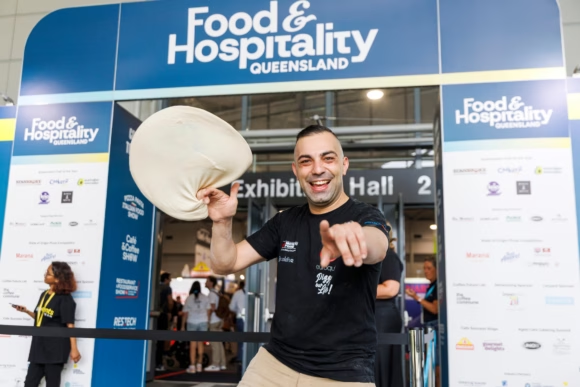
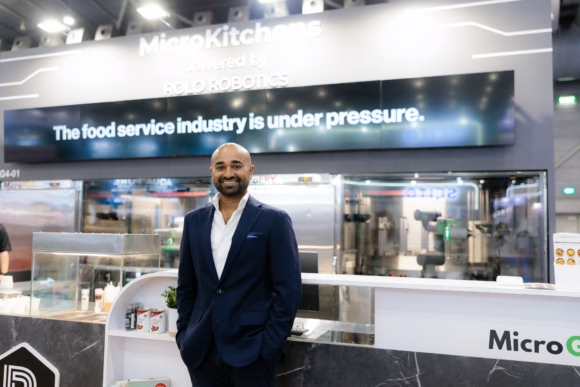
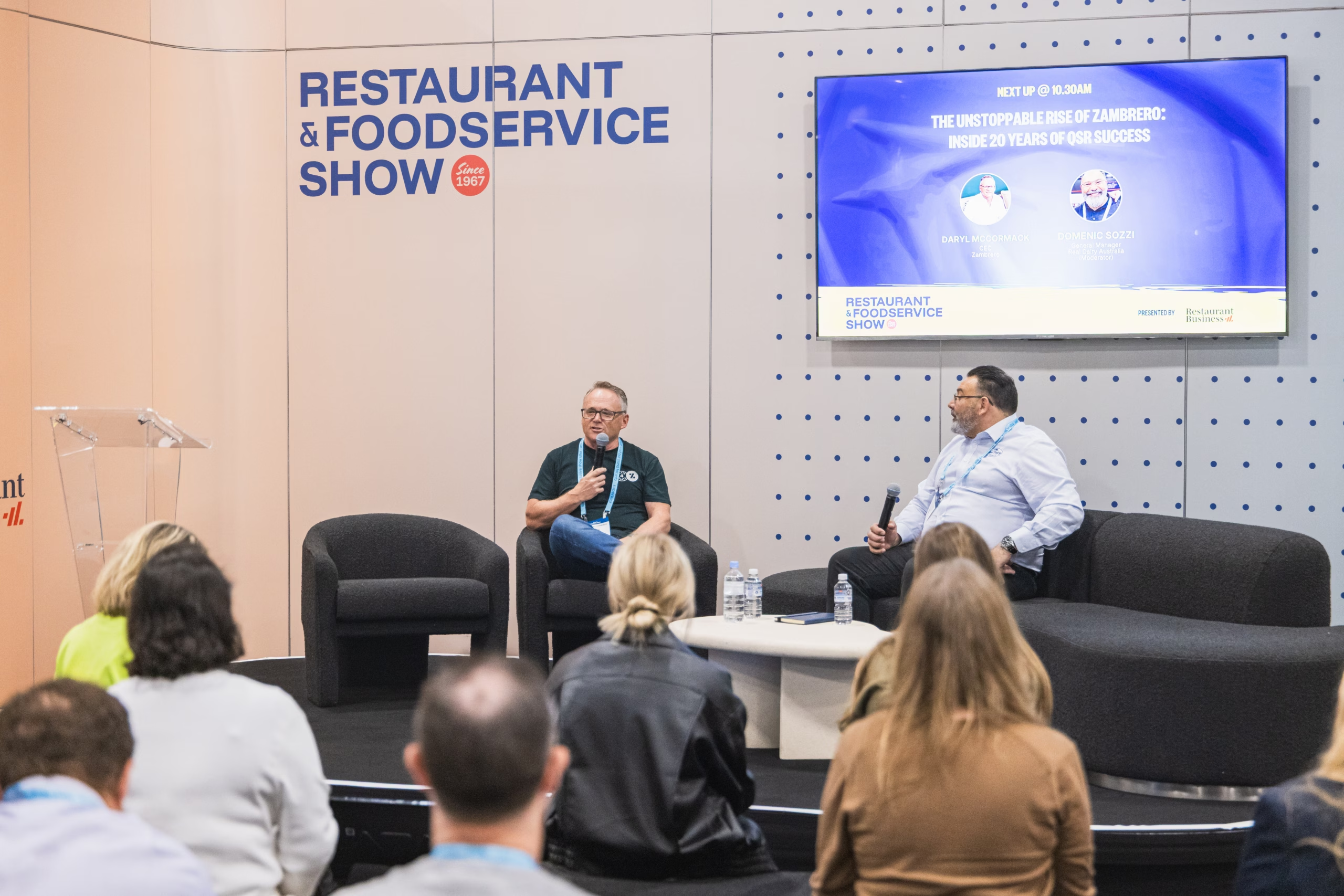
Daryl McCormack spoke at Food & Hospitality Week on the Business Stage. The session was moderated by Domenic Sozzi, General Manager of Real Dairy Australia.