Ask any hotel operator what a restaurant needs to be and you’ll get some version of the same answer: everything, to everyone, all at once. Breakfast for the business traveller out the door in twenty minutes. Lunch for the family killing time before checkout. Room service at 11pm for the guest who doesn’t want to get dressed again. And, increasingly, dinner for a table of locals with no reservation at the hotel at all, who simply want a good meal.
At Food & Hospitality Week Sydney in May, a Business Stage panel of some of Australia’s most experienced hotel and restaurant operators (Luke Mangan, Giovanni Pilu, Anna Pavoni of Maestro Hospitality, and Accor’s Ben Creek) worked through exactly this tension: how do you design a single dining room for wildly different people with wildly different needs, without ending up serving no one particularly well?
The problem, named
Moderator Rebecca Jarvey Gibbs put it to the panel directly: a hotel restaurant has to serve the hotel guest, whether solo traveller, family or business traveller, each with different needs across breakfast, lunch and late-night dining, while also winning over locals, because a restaurant that doesn’t feel part of a city’s cultural fabric won’t be truly embraced. Her framing of the risk was blunt: “if you’re something for everyone, you’re nothing.”
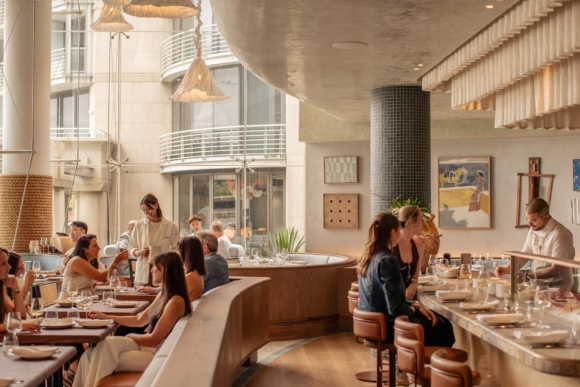
Anna Pavoni’s answer was that the fix isn’t a menu built to please everyone, but an operator with the license to build something specific. Individual operators partnering with a hotel matter, she said, “because they can actually tailor a concept and create something magical based on the space, rather than just a plug-and-play hotel dining room situation.” Done well, she added, a guest walks into a hotel restaurant and it simply “feels real. It feels like there’s personality. It feels like there’s people who care.”
The surprise at Flaminia
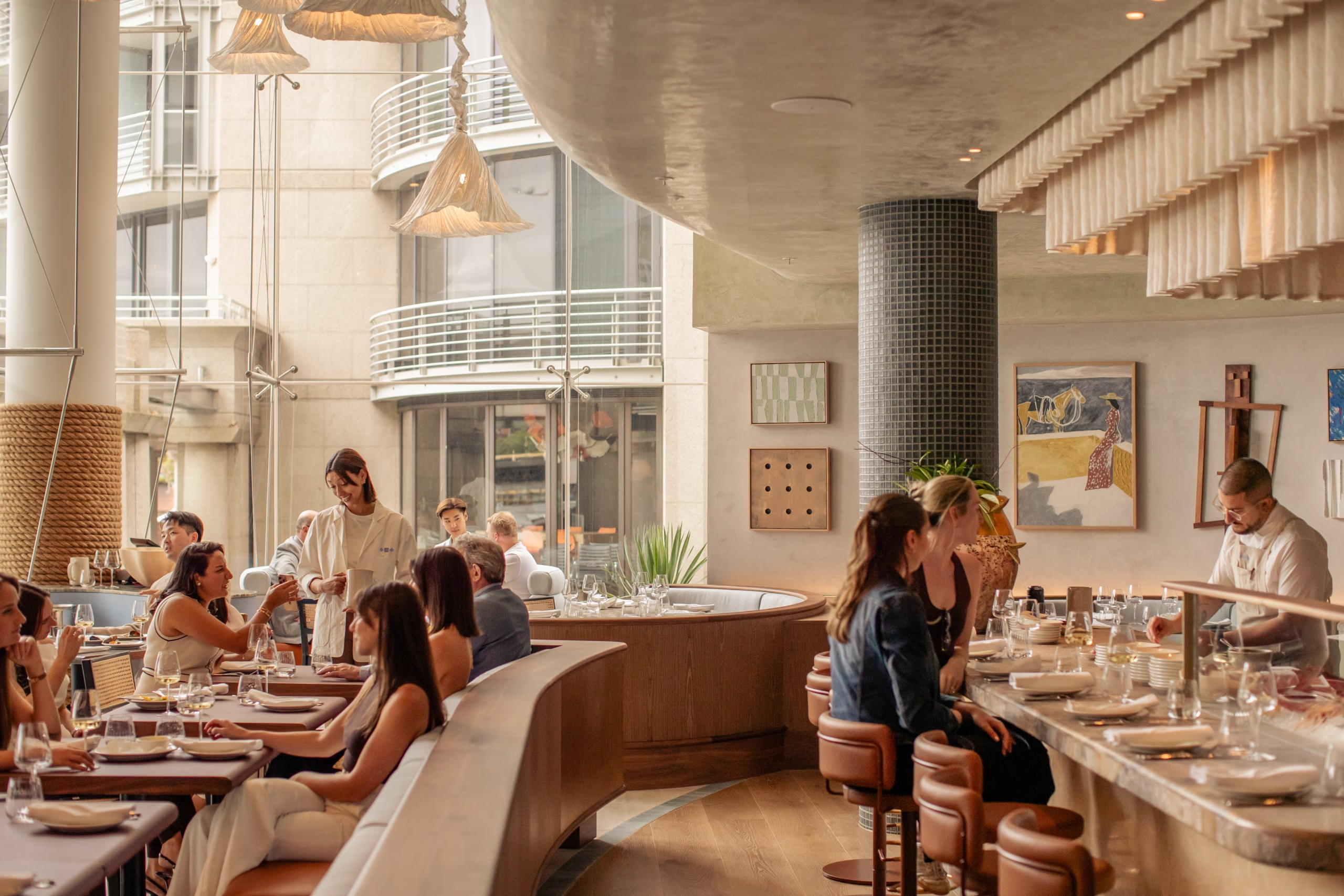
Giovanni Pilu’s experience at Flaminia, his six-month-old restaurant at Accor’s Pullman Circular Quay, became the panel’s clearest case study in how quickly the guest-local split can tip. Going in, Pilu wasn’t confident the hotel’s own guests would be enough to sustain the room, admitting “the hotel is not even very big.” What he didn’t anticipate was how many locals would treat the restaurant as their own neighbourhood spot rather than a hotel amenity:
“I didn’t realise how many locals actually come into Flaminia, because we’re in a great demographic. Living on the Northern Beaches, I assumed people would work in the city and just go home. But people live near where we are, up and down Macquarie Street, and they’re coming into Flaminia. So it’s not just about servicing the hotel, it’s about servicing the community.”
He credited the location’s connectivity, including ferries and rail, as part of the draw, but the underlying point was about design, not just geography: a restaurant built to feel like a genuine neighbourhood destination, rather than a hotel dining room with a nice name, pulls a local crowd whether or not the operator planned for it.
Pavoni made the same case in reverse, describing a hotel as a precinct rather than “rooms and one restaurant,” an ecosystem where the restaurants worth talking about are the ones that read as part of both the community and the building they sit inside.
Focus versus footprint
Ben Creek framed the operational side of the same problem in structural terms, pointing to a specifically Australian constraint. Compared with hotel markets overseas, where large properties can support a genuine spread of dining concepts under one roof, Australian hotels don’t have the scale to spread the load:
“It’s more challenging in Australia because our hotels have smaller footprints. If you go to Asia, other parts of the world, you’ve got three, four, five, six, in some cases ten, restaurants in a property, so you can be very focused about each concept. It’s a bigger challenge here, but for me, a focused menu and a focused concept will always outperform an all-day dining restaurant.”
That leaves Australian hotels with a harder trade-off than their overseas counterparts: rather than opening a breakfast room, a casual all-day café, a fine diner and a bar as four separate, purpose-built spaces, most need one restaurant to flex across all of it. Creek was candid that this hasn’t been resolved so much as managed, and breakfast in particular remains a sticking point. “A lot of people want to remove the buffet,” he said. “There’ll always be a space for it, but it needs to evolve, to be more sustainable, and to not feel like you’re sitting in an airport lounge when you’re having dinner.”
Mangan offered a counterintuitive data point on just how far a focused concept can carry a room, regardless of physical constraints most operators would consider fatal. His restaurant Glass opened on the second floor of a hotel with no street-level entrance and, in his words, “no visibility, really,” and still turned over $10 million in F&B revenue in its first year, a run that lasted more than twenty years. Visibility and floor plan, in other words, mattered less than the strength of the concept itself: “It happened to be a restaurant that happened to be in a hotel,” rather than a hotel restaurant designed around servicing the building first and a dining identity second.
That doesn’t mean flexibility disappears entirely inside a focused concept, it just moves from the menu to the floor. Mangan pointed to guest requests as the one place a hotel’s infrastructure gives an operator room a standalone restaurant often doesn’t have: “If a customer wants a well-done steak with a fried egg and crispy onions on top, and it’s not on the menu but we have the ingredients, we do it. The hotel environment gives you that accessibility, because you’ve got a burger or whatever available through room service.” The kitchen infrastructure built for room service becomes the same infrastructure that lets a focused restaurant quietly say yes to the guest who wants something off-script, without diluting the concept for everyone else.
The through-line: specificity over reach
What emerged across the panel wasn’t a formula for satisfying every audience at once, but near-unanimous agreement that trying to do so is the wrong goal. Pilu’s experience shows a restaurant designed around a strong sense of place will find its local audience without diluting itself to chase one. Mangan’s $10 million year on a hidden second floor makes the same case more starkly still: a strong enough concept can overcome constraints (poor visibility, no street entrance, a building designed around something other than dining) that most operators would treat as dealbreakers. And the steak-and-fried-egg example is the reminder that focus and flexibility aren’t actually opposites. The trick is knowing which one belongs on the menu, and which one stays in the kitchen’s back pocket for the guest who asks.
This article is based on insights shared during a panel discussion featuring Luke Mangan, chef and owner of Luke’s Kitchen at Kimpton Margot Sydney; Giovanni Pilu, chef and owner of Flaminia at Pullman Quay Grand Sydney Harbour; Anna Pavoni of Maestro Hospitality; and Ben Creek, Vice President Food & Beverage Asia & Pacific at Accor, moderated by Rebecca Jarvey Gibbs, co-founder and COO of Example. The session, “Checking In for Dinner: How Hotels Became World-Class Dining Destinations,” was part of the speaker program at Food & Hospitality Week Sydney, May 2026.