Australians are still going out — but they’re increasingly going Dutch.
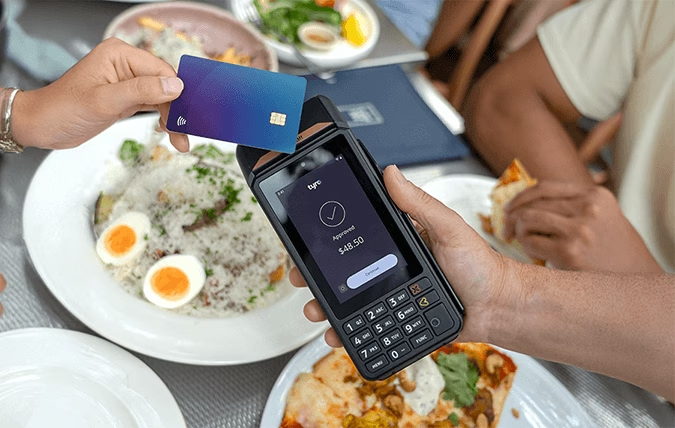
New data from payments company Tyro’s 2026 Eat Pay Love report reveals a significant shift in how consumers approach the social rituals of dining and drinking, with cost-of-living pressure driving a fundamental rewiring of bill-splitting behaviour and group spending norms.
Half of Australians (50%) now prefer to pay only for their own order when eating or drinking out, compared to just 17% who prefer to split the bill evenly and 9% who prefer to take turns shouting.
The findings suggest that the communal, easygoing approach to group dining that has long defined Australian hospitality culture is giving way to a more calculated approach.
Nowhere is that more visible than in the rise of QR code ordering. More than one in three Australians (37%) say they use QR code ordering specifically to avoid awkward money conversations with friends. Among Millennials, that figure climbs to 44% — nearly half choosing a technology workaround over a direct conversation about who’s paying for what.
The tradition of buying rounds is fading, too. One in three Australians (32%) says they are less likely to buy a round of drinks than they were a year ago. While Gen Z are more likely than older generations to shout, the overall direction is clear: communal spending is declining.
Drinking and tipping culture is changing
Drinking habits more broadly are under pressure. Fifty-one percent of Australians say cost pressures have changed how they drink over the past year. Nearly three in 10 are drinking less, almost one in 10 are switching to cheaper options, and a further 13% say they have cut down or stopped drinking alcohol altogether. Gen Z are most likely to have stopped drinking entirely, at 18%, followed by Millennials at 14%.
Tipping — never a deeply embedded habit in Australia — is becoming even rarer. Nearly two thirds of Australians (65%) say they never tip when eating out or going to the pub, and a further 11% say they are tipping less due to cost-of-living pressures.
Tyro’s own transaction data underscores the point: just one in 100 restaurant transactions included a tip in December 2025.
For operators, the implications are practical. Guests engineering their way around communal spending — whether by ordering via QR code, requesting separate checks, or simply drinking less — affects average check size, service flow, and the rhythm of a meal. A table of six paying six separate tabs behaves differently from a table running one.
The generational picture adds another layer of complexity. Gen Z and Millennials say they are willing to pay 23% more for coffee and 14% more for beer than Baby Boomers — suggesting younger guests have higher price tolerance even as they pull back on volume and group spending.
Understanding which levers are driving restraint, price sensitivity versus a broader cultural shift away from alcohol and communal tabs, will matter for how operators design their offer in the months ahead.
The Eat Pay Love report surveyed Australian consumers and small business owners and is based on both survey data and Tyro transaction data.